FAQs
How does the water stay clean?
Clear, clean water is the naturally occurring state in low-nutrient ponds and lakes if the body of water is large and deep enough. Swimming ponds are purposely built to emulate this state and are a prime example of how we can harness nature's intelligence effectively.
A conventional swimming pool uses chemicals to kill micro-organisms in the water such as phytoplankon (microscopic single-celled algae, which in abundance make the water go green) and bacteria. However this isn’t necessary in a natural pool where the cleaning work is carried out by micro-organisms which exist together in equilibrium.
This is the basic principle of a swimming pond - to use the natural purifying properties of plants and micro-organisms to sustain clean, clear and healthy water.
So you don't have a filter then?
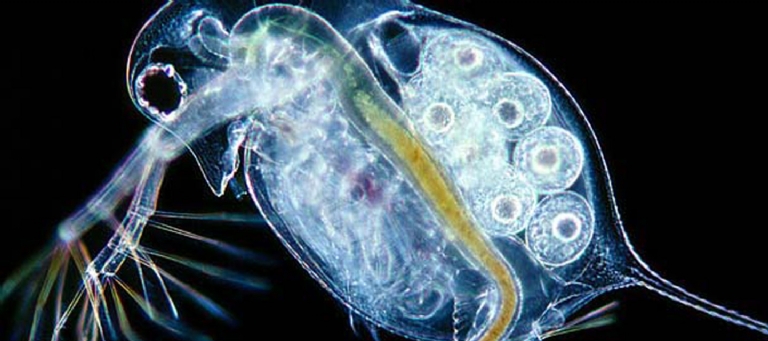
In natural water, the main filter is the whole water body, as each part of water is constantly being filtered by microscopic life-forms.
However, in swimming ponds it is also essential to keep the nutrient levels very low, to ensure that single-celled algae are always controlled by zooplankton, and to prevent the growth of blanket weed (string algae). To do this we filter the water through shingle and other mediums using a small pump. Plants also perform a useful function taking nutrients out of the water as they grow. By keeping the levels of key nutrients low and in balance, algae is not able to grow or is very minimal, and the result is clear, clean and healthy swimming water.
We use standards required by the German swimming pond association (more stringent than the International swimming pond standards, which are adopted by default by the British Association of Natural Swimming Pools), which are used in hundreds of public swimming ponds in Germany and thousands of private swimming ponds.
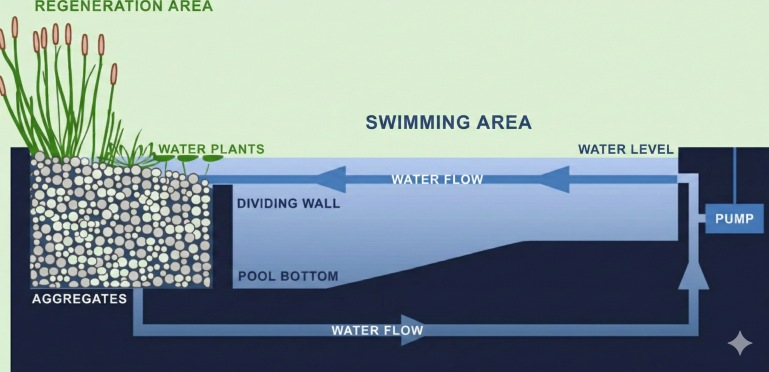
Below is a very simplified drawing of how our filter system works - in reality there are many elements which go into making up an effective filtration system but this shows the basic principle:
How much maintenance is needed?
A swimming pond needs much less maintenance than a conventional pool, as there are no chemicals to add and manage and the water does not need to be drained for cleaning and repairs
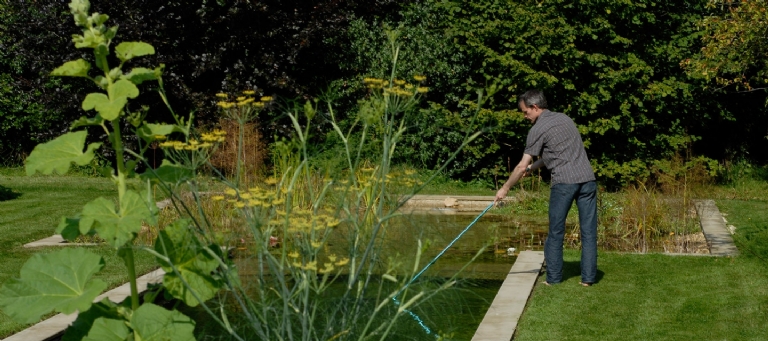
Nature itself carries out most of the cleaning service, but it is still a living and growing part of the garden and it needs looking after in a similar way. The key to managing time spent on maintenance is ensuring the pond receives a small amount of regular attention. This amounts to emptying the skimmer and ensuring that any leaves which may have blown in do not build up in large quantities.
Removing leaves (and discouraging ducks from visiting the pond) helps to keep the water's nutrient levels low. On this basis (i.e. no extreme nutrients enter the pond) we can guarantee the water to be completely clear all the time.
Many people like to spend time looking after their pond themselves. However we also have a dedicated maintenance team and offer a maintenance service which can be as often or infrequent as you need. We generally recommend that our maintenance team visits at least once a year to check on the pond's development and its equipment.
How much does a natural swimming pond or pool cost?
Costs can obviously vary and are mainly dependent on size and style, and other factors such as the features.
Naturalistic swimming ponds are the easiest to estimate fairly accurately, because although the shape of each pond is unique the basic features tend to be similar. Please bear in mind that the planting/filtration zone around the central swimming area needs to be 2m in width, so if you have a total length of 20m, say, your swimming length will be 16m. And a total width of 10m would give a swimming width of 6m.
Also a rule of thumb which may be useful is that you can approximately work out the total pond area by calculating total length x total width x 85%. So a pond with dimensions 20m x 10m would have an approximate area of 20 x 10 x 0.85 = 170 sqm.
So as long as you have stable soil (e.g. clay, chalk), and simple features (e.g. a stone step entry, timber jetty, and jumping rock with stepping stones), total project costs, including design and construction, start from around £150,000 incl VAT, are around £200,000 incl VAT for a pond about 170 sqm as mentioned above, and around £300,000 incl VAT for a large pond about 30m long.
For semi-formal swimming ponds costs are harder to initially estimate, but are about 35% higher than natural designs for the same swimming area. This is because of the addition of the blockwork wall, coping over the wall, and a more labour-intensive liner application process. For example a semi-formal swimming pond would start at around £200,000 incl VAT, and would be around £250,000 incl VAT for a swimming length of around 12m.
If you would like a more accurate cost for your specific situation please call or email us - we can usually provide you with an indicative design, and a quote relating to that design. This will include some listed assumptions and these, as well as the design of course, will need to be confirmed during a site visit. For more details about this process please see here.
What happens in the winter?
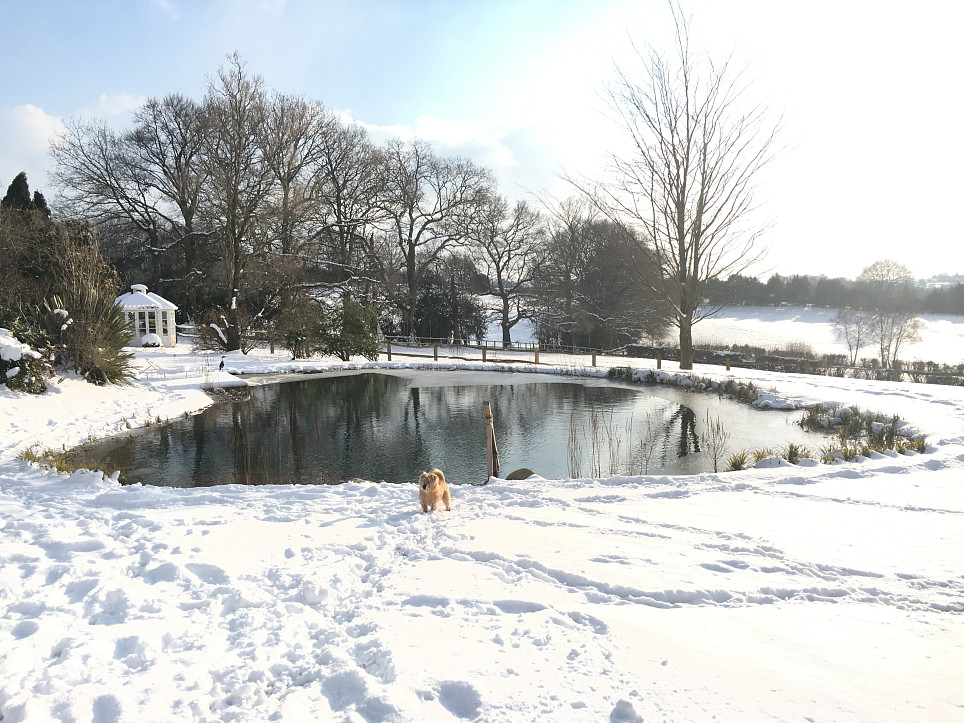
One advantage of a swimming pond over a conventional pool is that a pond looks beautiful all year round. The water is not emptied and in fact the more mature and established the water is in a swimming pond, the more stable it becomes. Constantly alive and evolving, our ponds change with the seasons, maturing over the years and allowing the plants to grow into their habitat.
Our filter systems have a "summer" and a "winter" switch - over winter the pump is off nearly all the time as the pond lies largely dormant, ready for the increase in temperatures in the spring.
In the autumn we cut back the plants to about 4-6 inches high. This ensures organic matter doesn't fall back into the pond and decompose, so the nutrient level in the water stays low throughout the winter, ready for the spring.
Do we need planning permission?
Swimming ponds currently fall into the same official category as swimming pools, and according to current regulations (Town and Country Planning Act 2015, Part 1, Class E) you generally do not need planning permission if:
- Your property is not listed, and
- The site is within the curtilage of the property, and
- You are not in an Area of Outstanding Natural Beauty (AONB)
The regulation stipulates other requirements but these three are nearly always the main ones. In addition you should be aware if permitted development rights have been withdrawn for any reason (usually at the time of previous development), or if there are any tree preservation orders (TPOs) on trees which are close to the pond or necessary access routes.
If your property is listed, or if you want to build on agricultural land, or if you are in an AONB, then planning permission will be required.
We have a lot of experience in getting planning permission for swimming ponds and still have a 100% success rate in more than 150 applications spanning 22 years, so please talk to us if you need to discuss further your specific situation.
Can you heat the water?
This is a common question in the UK and the answer is yes, the water can be heated to 27 degrees C or in some special cases higher than that. (For example we built a pool and heating system enabling the swimming water to be at 30 degrees C all year round, but this required a very specific design.)
However we generally recommend that people try their pool first, for one season, without heating. We can always install the necessary pipework during the construction stage and, if required, connect it to a heating system at a later date.
People very often ask about heating when we first talk to them, but we almost always find that once they are swimming in the pond, temperature is not the issue they thought it was beforehand. Particularly for natural designs, water in the shallow areas heats up quickly in the sun and can raise the natural temperature of the whole pond to 24-26 degrees C in summer periods. (Our record for an unheated naturally designed swimming pond is 28C, or 82F.)
Perhaps as importantly, natural water feels much more comfortable on the skin and is not as "harsh" as chemical water. So what might feel cold in chlorinated water, 22 degrees C for example, actually feels comfortable in natural water.
But the bottom line is yes - we can heat your swimming water, basically to whatever temperature you like.